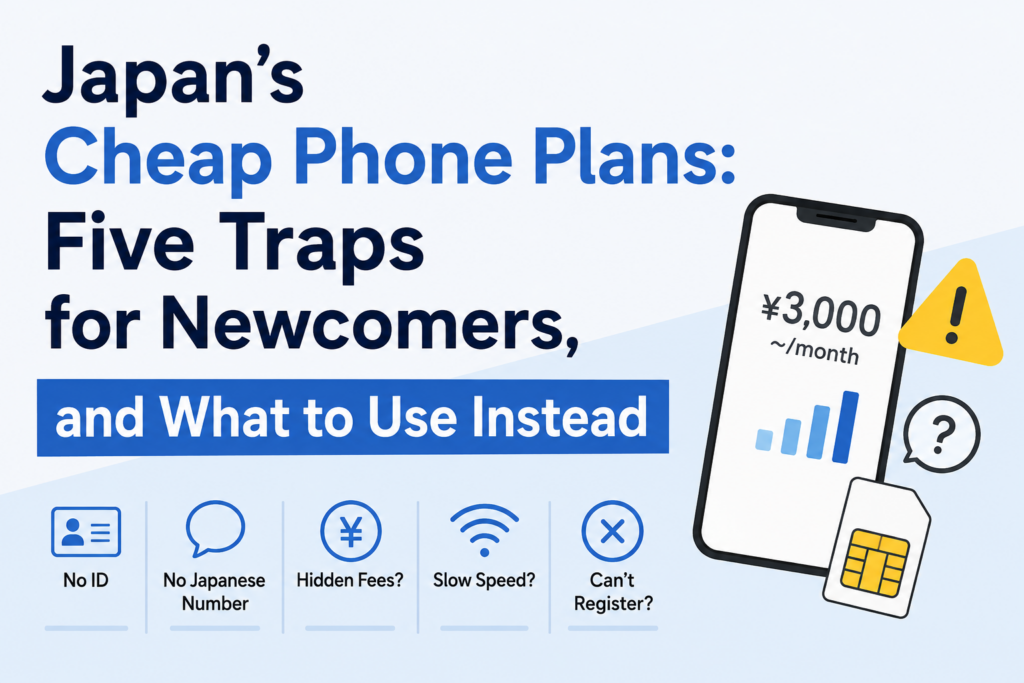
If you’re coming to Japan for a working holiday, to study, or to work remotely for a while, you’ve probably found ahamo, LINEMO, povo or Rakuten Mobile. Around ¥3,000 a month for 20–30GB, on networks that genuinely are fast and reliable.
Then you try to sign up and it doesn’t work.
You can’t get these plans before you arrive, and you almost certainly can’t get them in your first few weeks either. People lose days to this, refreshing error screens in a hotel room. Here’s what’s actually blocking you, four other things that catch people out, and what to use in the meantime.
Checked against provider sites in August 2026, tax included. Prices move around, so confirm before you buy.
Trap 1: The cheap plans need an address you don’t have yet
What people assume: “I’ll order an ahamo eSIM the week before I fly.”
Japan’s budget plans are built for people who already live here. Signing up means:
- A residence card with your address printed on it. You get the card at the airport, but the address only goes on after you’ve rented somewhere and registered at your local ward office. That’s realistically a few weeks.
- A Japanese credit card or bank account. Overseas cards usually fail the authentication step on domestic telecom sites, even when the card itself is fine.
- A Japanese-language signup flow. Support in English is limited to non-existent, and a phone shop won’t sort out an online-only plan for you.
None of this is a judgement about you. These brands simply aren’t built for anyone who hasn’t settled in yet. Once you have, they’re a good deal and worth switching to.
Trap 2: A data-only eSIM will slowly strand you
What people assume: “Airalo is fine. I just need maps and WhatsApp.”
For a week, that’s true. For a few months, it isn’t, because a data-only line has no Japanese number — and an enormous amount of daily life here runs on an SMS code sent to a 070, 080 or 090.
Without one you can’t register for LINE, which is how the country actually talks to each other. Also closed: PayPay and other payment apps, Mobile Suica, food delivery, taxi apps, Shinkansen booking, ticketing sites, and the restaurant reservation systems the good places use. Then the slower problems arrive — opening a bank account, signing a lease, applying for part-time work. All of them want a number that can receive a text.
050 VoIP numbers don’t fill the gap. Japanese verification systems reject them, because SMS travels over the voice network and 050 lines aren’t on it.
Trap 3: Check your phone is unlocked before you fly
Some phones only work with the carrier they were bought from. If yours is one of them, no Japanese SIM will connect — and you’d find out at the airport, which is a bad place to find out.
It takes ten seconds to check.
iPhone: Settings → General → About, scroll to Carrier Lock. If it says “No SIM restrictions,” you’re fine. Android: Settings → About phone → SIM status. If you’re not sure what you’re looking at, ask your carrier.
If it is locked, contact your carrier and ask them to unlock it. It’s usually free and usually quick, but it can take a few days, so do it now rather than the night before your flight.
If you’re already in Japan and stuck, renting a pocket Wi-Fi at the airport will keep you online while you sort it out.
Trap 4: What happens to your home country’s SMS codes?
A fair worry: if you switch to a Japanese SIM, do you stop receiving the verification codes your bank and Google send to your home number?
You don’t. Keep your home line alive and let the Japanese SIM handle data. Those are two separate settings.
- Home SIM: leave it on, but turn data roaming off. Receiving a text is free with most carriers — worth confirming with yours before you leave.
- Japan SIM: mobile data on, and use this one for data.
Switch the home SIM off entirely, or take it out, and the codes stop with it. Forget to turn data roaming off, and your home line will quietly use data and bill you for it. Get the on and the off the right way round and you’re covered.
Trap 5: “No credit check” and “no ID check” are different things
These get confused constantly, and the confusion is why some people expect a difficult approval process that doesn’t exist, while others get caught out by a step that does.
Credit and income screening: not required. Foreigner-focused providers don’t look at your salary, your job, your credit history or whether you have a guarantor. There’s nothing to pass.
Identity verification: required by law for any line with a phone number. Since April 2026 this can’t be completed online with a passport — the old photo-and-selfie method was scrapped. So you order online, then show the real passport at an airport or city counter and collect your SIM, or a paper voucher with your eSIM access code. Two minutes, and there’s no waiting period, because there’s no approval step to wait on.
Data-only eSIMs don’t currently carry that requirement, which is why they arrive by email.
One consequence worth remembering: anyone advertising a real Japanese number delivered instantly by email with no ID step is describing something that can’t legally exist.
What works, and what doesn’t
| Japanese budget plans (ahamo, LINEMO, povo) | Data-only eSIM (Airalo, Ubigi) | Mobal / Sakura Mobile | |
|---|---|---|---|
| Available before you arrive | No | Yes | Yes |
| Documents needed | Residence card with address, Japanese bank or card | None | Passport |
| Japanese phone number | Yes | No | Yes |
| Can receive SMS codes | Yes | No | Yes |
| How you get it | Post or online | Email, instantly | Counter pickup |
| Payment | Japanese card or bank account | Overseas card | Overseas card, PayPal |
| Support in English | Little to none | App and chat | Yes |
| Suits | Residents who’ve settled in | Trips under two weeks | Working holiday, students, long stays |
Those two bold rows are most of the decision.
What to actually use
Staying under two or three weeks, and don’t need to register for anything local? A data eSIM is the cheaper, simpler answer. Ubigi runs on docomo and holds up outside the cities; Airalo is the easier app and fine for light use. Neither gives you a Japanese number, so if you think you’ll want restaurant bookings or a payment app, it’s worth reading Trap 2 again before deciding.
Staying a few months or longer? You need a real number, and until your residence card has an address on it, two providers can give you one on a passport.
Mobal
Cheaper to start: ¥4,950 for the SIM or eSIM with no separate activation fee, then from ¥1,650 a month for voice plus data. There’s also a voice-only plan at ¥1,430, which is the cheapest legitimate Japanese number a foreigner can hold — useful if you’ll be on Wi-Fi at home and at school and just need something that catches verification codes. No minimum term and no cancellation fee, so you can stop the week you fly home. Runs on docomo. Takes overseas cards and PayPal.
The honest caveats: you have to collect it in person, and it isn’t the cheapest plan in Japan by any measure — ahamo will beat it once you’re eligible. Leaving and re-entering Japan often is expensive too, since roaming is an add-on at ¥5,995 each time you switch it on.
Get Your Japan SIM Card → Both plans include a real Japanese phone number.
Choose eSIM if your phone supports it — otherwise the physical SIM works with any unlocked handset.
Sakura Mobile
Also docomo, also passport-only at pickup, also English support, and the better-known name among long-term residents. The difference shows up on day one: ¥5,500 in activation fees against Mobal’s zero, and the entry plan starts at ¥3,278 rather than ¥1,430. There’s a one-calendar-month minimum term.
If you’re a student, ask about their activation-fee discount before you decide — it closes some of the gap.
Either one will do the job. The gap between them is smaller than the gap between having a Japanese number and not having one.
Common questions
Can I switch to ahamo or LINEMO later? Once your residence card shows your address and you have a Japanese bank account, the whole domestic market opens up, and there’s far more choice at the cheap end than anything aimed at foreigners. If you want to keep your number when you move, ask your provider about porting before you commit — the documentation on that isn’t always consistent.
Will I be charged for incoming SMS from my home bank? Most carriers worldwide don’t charge to receive a standard text abroad, though sending one or answering a call will cost you. Check with yours before you leave, since policies vary more than you’d expect.
How long does the ID check take? No time at all with counter pickup — it happens at the counter. What to watch is opening hours, not processing. Haneda Terminal 3 runs 4am to 1am; Narita Terminal 2 closes at 9pm. For a late landing, book a city pickup for the next day and use airport Wi-Fi in the meantime.
Do I need a Japanese bank account? No. An overseas credit or debit card is fine, and Mobal also takes PayPal if your card gets blocked.
What if I’m under 18? You can’t hold a voice line in your own name. A parent or guardian can order in theirs, but they’ll need to collect it in person, since the ID has to match the order.