

I’m writing this from an Oakhouse share house in Nakameguro, Tokyo, where I currently live.
That matters, because most English-language advice about renting in Japan is written by people who haven’t done it. It describes the traditional rental market — guarantors, key money, four to six months’ rent before you get the keys, and a residence card you won’t have for weeks after you land.
Share houses work differently. And Oakhouse in particular is set up so you can reserve a room from your home country and move in the day you arrive.
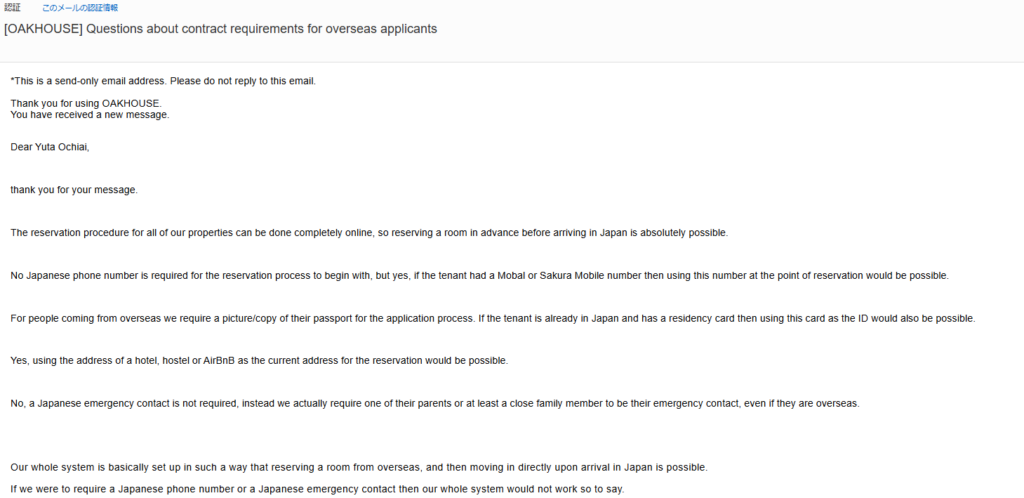
I asked them directly to confirm the details, because I didn’t want to write this from assumption. Their answers are below.
Checked with Oakhouse in September 2026.
Yes, you can book before you arrive
I asked whether an overseas applicant could reserve a room before flying to Japan. The answer was unambiguous: the reservation process is entirely online, so booking a room in advance from overseas is possible.
Then they added the part that explains everything else:
Our whole system is basically set up in such a way that reserving a room from overseas, and then moving in directly upon arrival in Japan is possible. If we were to require a Japanese phone number or a Japanese emergency contact then our whole system would not work so to say.
That’s not a company making an exception for foreigners. That’s a company that built the process around them.
What you actually need
Short list.
A photo or copy of your passport. That’s the ID requirement for applicants coming from overseas. If you’re already in Japan and hold a residence card, you can use that instead — but you don’t need one.
An emergency contact. Here’s where it gets easier than you’d expect, not harder. Japanese rentals usually demand a contact inside Japan, which is a real problem when you don’t know anyone yet. Oakhouse asks for a parent or close family member, and explicitly says they can be overseas.
A current address — which can be temporary. Staying in a hotel, a hostel, or an Airbnb? You can use that address on the application.
And what you don’t need:
- ✕ Residence card
- ✕ Japanese phone number — a Mobal or Sakura Mobile number works if you have one, but isn’t required
- ✕ Japanese emergency contact
- ✕ Guarantor
- ✕ Deposit, key money, or agency fee
If you’ve been reading about Japanese rentals and bracing yourself, that list is the whole point of this article.
What it costs
This is the number people want first, so here it is plainly.
¥50,000 contract fee, paid once. Then your first month’s rent, prorated from your move-in date — arrive on the 20th and you pay for eleven days, not a full month. After that, monthly rent plus utilities, with utilities usually included in the quoted price.
For comparison, a conventional Tokyo apartment typically wants four to six months’ rent upfront once you add deposit, key money, agency fee and guarantor company fees. On a ¥90,000 apartment that’s ¥360,000 to ¥540,000 before you’ve bought a fork.
The share house route gets you into a furnished room for ¥50,000 plus part of a month’s rent.
How it works, step by step
1. Search the official site — and don’t wait
Filter by area, budget, room type and facilities. This is the step that decides everything else, and it’s the one people leave too late.
Rooms in popular areas do not sit empty. I live in Nakameguro, and there hasn’t been a single vacancy in my house for six months. That’s not unusual — central Tokyo houses fill and stay full, and when a room does open it’s often taken within days by someone already in Japan who can move immediately.
So look now, even if your flight is months away. Seeing what’s actually available changes how you plan.

2. Apply online
The whole form is online and in English.
3. Send your passport
A photo or scan is fine.
4. Get confirmation
Your room is held for your arrival date.
5. Land and move in
You can go from the airport to your room the same day.
When to start looking: two to three months before you fly is sensible, and earlier is better if you have a specific area in mind. If your first choice is full, look at the neighbouring stations rather than waiting. The difference is often ten minutes on a train and ¥10,000 a month.
Choosing the right house: the thing nobody tells you
This decision determines whether you enjoy living in one, and it’s simpler than it looks.
Large houses are social. Small houses are quiet. That’s most of it.
In a big property with a large shared lounge, you’ll meet people constantly whether you planned to or not. In a small one, you might exchange greetings in the kitchen and that’s it. Neither is better — they suit different people, and plenty of people pick wrong because they only looked at rent and station distance.
There’s a third option I’d recommend to anyone unsure, and I don’t see it mentioned anywhere:
Live somewhere small and private, and use the events for your social life.
Oakhouse runs a lot of events across its properties — language exchanges, seasonal parties, that kind of thing — and you can attend them regardless of which house you live in. So you get a quiet room with real privacy, and still meet people whenever you want to, rather than at midnight in your kitchen when you’re tired.
If you want company on tap, take the big house. If you want it on demand, take the small one and go to the events.
Honest notes from living in one
Bathrooms and kitchens are usually shared. This is what people worry about most, and in practice it’s fine. Facilities are typically split by gender, there are usually multiple bathrooms, toilets and washing machines rather than one of each, and cleaning staff come in. It’s cleaner than a share flat you’d organise yourself.
Rooms come furnished, but not equipped. You’ll typically get a bed, a fridge, a desk and chair, air conditioning and curtains. You won’t get towels, a hairdryer, shampoo, or anything else you’d find in a hotel. It’s an apartment, not accommodation — bring or buy the small stuff.
The contract is in Japanese. Not a problem in practice: run it through a browser translator or a phone camera translation app before you sign. The support conversation happens in English; the document itself is a Japanese legal form.
A phone number isn’t needed to book, but you’ll want one soon after. You can reserve and move in without any Japanese number. Once you’re settled, though, LINE, payment apps, bank accounts and delivery services all want one, so it’s worth sorting out in your first week or two.
Common questions
What if the house doesn’t suit me? You can move. If something’s wrong with the room, the facilities, or another resident, contact Oakhouse support first — they respond quickly and most things get resolved that way. If it still isn’t working, you can transfer to a different property for a ¥50,000 fee, the same as the original contract fee. There’s no restriction on where you move to: expensive house to cheaper one, a regional property to central Tokyo, whatever suits.
This is worth knowing before you book from overseas. You’re choosing from photos, so it’s reassuring that a wrong guess isn’t permanent.
What’s the minimum stay? One month. Contracts come in three lengths: one to six months, one year, or two years.
How much notice to move out? Fourteen days for a dormitory room, one month for other room types.
Can I move between properties? Yes — moving between Oakhouse houses is part of how the system works. Useful if you take a room to get settled, then decide you’d rather be somewhere else.
Who else lives there? Around 70% of residents are from outside Japan, from roughly 100 countries, alongside Japanese residents. It’s a mix, not an expat bubble.
How many properties are there? Over 6,000 rooms across the greater Tokyo area.
Do I need to speak Japanese? Not to apply or to live there. Support is available in English.
Can I view a room before committing? If you’re already in Japan, yes. From overseas you’re relying on photos and floor plans — that’s the trade-off for securing a room before you land.
In short
Book from home with a passport photo. No residence card, no Japanese number, no guarantor, no deposit. ¥50,000 plus a prorated first month, and you can move in the day you arrive.
Start looking two or three months out — earlier if you want central Tokyo, because those rooms genuinely don’t come free often. Decide whether you want a big social house or a small quiet one, and remember you can attend the events either way.
I live in an Oakhouse property, and this page contains affiliate links. If you book through one, we may earn a commission at no extra cost to you. It doesn’t change what I’d recommend.