Are you moving to Japan on a working holiday, a student visa, or as a freelancer, and worried you’ll be turned down for a phone plan because you have no job here yet?
The worry is understandable. Applying with Docomo, au, SoftBank or one of the budget brands underneath them can involve credit checks, proof of domestic employment and a Japanese bank account. Plenty of people have been sent away.
But the thing you’re afraid of doesn’t apply to you. There is no income screening, no credit check, no background investigation. What exists instead is an identity check, which is a completely different animal, and confusing the two is why this feels scarier than it is.
Here’s the difference, why it works this way, and the three realistic options.
Checked against provider sites in August 2026, tax included. Promotional pricing moves around, so confirm before you buy.
Credit check vs. identity check
Two different things get called “screening,” and separating them answers most of the question.
Credit and income screening — not required. Your salary, bank balance, credit score, employer, tax documents, guarantor. Foreigner-focused providers don’t look at any of it, because they have no reason to.
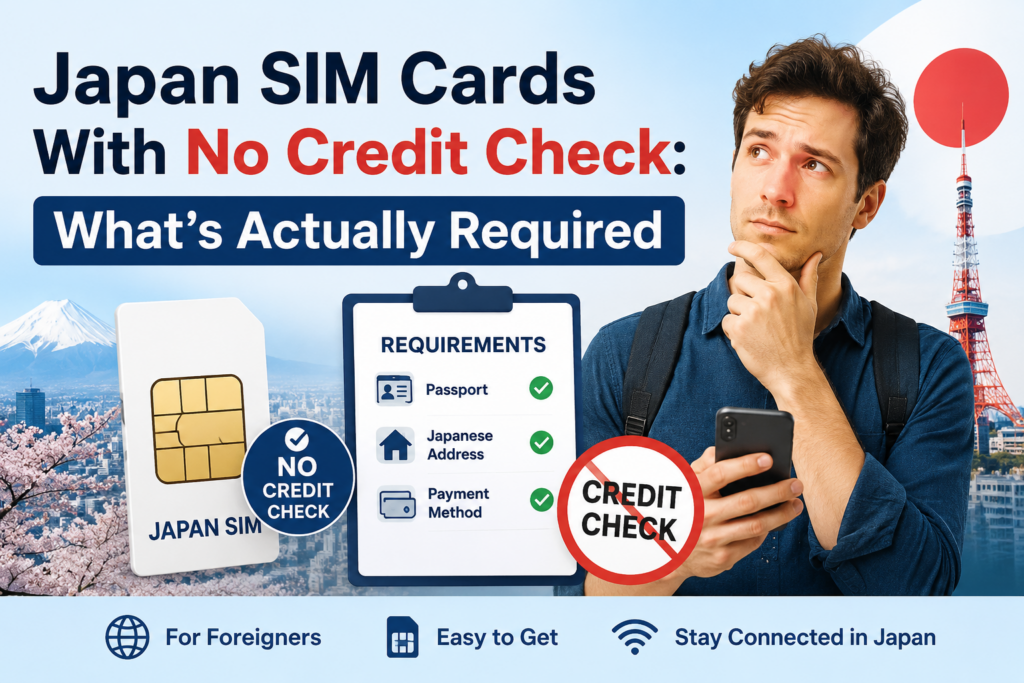
Identity verification — required by law for any line with a phone number. Japanese telecom regulations require providers to confirm you are who you say you are, using an official photo ID. For you, that’s your passport. This isn’t a judgement about you and there’s nothing to pass; they’re recording who holds the number.
Data-only eSIMs don’t currently carry even that requirement, which is why they arrive by email.
So: passport, a working payment card, and you’re in.
Why there’s no credit check
The big carriers screen because of what they’re actually selling. A handset worth ¥150,000 paid off over 24 or 48 months, billed in arrears, on a contract with a minimum term. That’s a loan with a phone attached, and lenders check borrowers.
Mobal and Sakura Mobile aren’t lending you anything:
- You bring your own phone. No device financing, so no debt to underwrite.
- Billing is to a card that’s already been approved. Your own bank at home did the credit assessment years ago.
- No lock-in. Nothing to recover if you leave.
Nothing to underwrite, so no underwriting. You’re not trying to pass something — either your documents are the right documents or they aren’t, and that’s usually fixable in an afternoon.
So who actually gets approved?
Working holiday with no job lined up. Language school and university students. People whose job starts next month. Freelancers and the self-employed. Remote workers paid by an overseas employer. Dependent visa holders with no income of their own. Digital nomads. Short-stay visitors with no residence card at all.
All fine. None of these are awkward exceptions the provider grudgingly accommodates — they’re the ordinary customer, and support teams handle these situations every day.
The one genuine no is being under 18. Voice lines in Japan are 18-and-over, full stop. A parent or guardian can order in their own name, but they have to be the one who collects it, because the ID has to match the order.
Your three options
| Data-only eSIM (Airalo, Ubigi) | Mobal | Sakura Mobile | Japanese carriers & budget brands | |
|---|---|---|---|---|
| Credit or income check | None | None | None | Often yes |
| ID required | None currently | Passport | Passport | Residence card with your address |
| Japanese phone number | No | 070/080/090 | 070/080/090 | Yes |
| Can receive SMS codes | No | Yes | Yes | Yes |
| How you receive it | Email, instantly | In person at a counter | In person at a counter | Post or online |
| Payment | Overseas card | Overseas card, PayPal | Overseas card | Japanese card or bank account |
| Minimum term | Prepaid | None | One calendar month | Varies |
| Application language | English | English | English | Mostly Japanese |
Those two bold rows are the whole decision. Everything else is detail.
Mobal — best for long stays, and cheapest to start. ¥4,950 for the SIM or eSIM with no separate activation fee, then from ¥1,650 a month for voice plus data. There’s also a voice-only plan at ¥1,430, the cheapest legitimate Japanese number a foreigner can hold, which is worth knowing about if you’ll be on Wi-Fi at home and at school and just need something that catches verification codes. No minimum term, so you can cancel the week you fly home. Runs on docomo.
Sakura Mobile — the better-known name, and a perfectly good service. Also docomo, also English support, also passport-only at pickup. The difference is day one: ¥5,500 in activation fees against Mobal’s zero, and the entry plan starts at ¥3,278 rather than ¥1,430. There’s a one-calendar-month minimum. If you’re a student, ask about their activation-fee discount before deciding — it narrows the gap.
Airalo or Ubigi — if you’re here for a fortnight. Cheapest, instant, no counter visit, no ID. The catch is in the bold rows: no Japanese number means no SMS codes from anyone, which closes off payment apps, Mobile Suica, restaurant bookings, ticketing sites and LINE registration. For a week of Google Maps and messaging, that’s a fine trade. For anything longer, it stops being one fairly quickly.
Note: a phone number means an in-person ID check
If you’re taking a line with a Japanese number, the identity check happens face to face. You order online, then collect at an airport or city counter, showing your passport. Physical SIM, they hand you the SIM. eSIM, they hand you a paper voucher with an access code that becomes your QR code. Two minutes, and it’s the same for both providers.
Data-only eSIMs skip this entirely, which is why they arrive by email.
From ordering to a working phone
1. Order online in English, choose your pickup point and date
     ▼
2. Land, show your passport and confirmation email at the counter
     ▼
3. Collect your SIM, or a paper voucher with your eSIM access code
     ▼
4. On Wi-Fi: activate, set the APN, restart. Your number arrives by email
There’s no waiting period, because there’s no approval step to wait on. Order in the morning, land in the evening, collect on the way out of the airport. Then give yourself about half an hour on hotel or airport Wi-Fi for step 4 — the APN is where people get stuck, and it goes much better sitting down.
What to watch is opening hours, not processing time. Haneda Terminal 3 runs 4am to 1am, which covers almost any arrival, but many city locations keep normal business hours. Landing at 11pm into Narita Terminal 2, where the counter closes at 9pm? Book a Tokyo pickup for the next day and use airport Wi-Fi in the meantime.
Delivery to your home country before you fly is slower — 13 to 18 business days to the US, 15 to 30 to Australia and Canada — and has ID requirements a passport alone often doesn’t meet. Inside a month of departure, take counter pickup.
The full walkthrough, including the APN step and what changed in the law in April 2026, is in a separate article: how to get a Japanese phone number without a residence card.
Three things to check before you order
Since approval isn’t the obstacle, the things that go wrong are all logistical. All boring, all avoidable if you look now rather than at the airport.
Is your phone unlocked? The big one, and it has nothing to do with anyone’s approval process — you’ll buy the SIM, collect it, and then find it won’t work. Phones bought on a US carrier plan are the usual culprits. On iPhone: Settings → General → About → Carrier Lock, where you want “No SIM restrictions.” Most carriers unlock a handset once it’s paid off, but it can take a few days, so start now rather than the night before you fly.
Does the name match everywhere? Order, passport and payment card should all carry the same name. Middle names, dropped hyphens, a parent’s or spouse’s card — any of these can hold things up at the counter. Type it exactly as printed in the passport.
Are you ordering from a company that can serve you? ahamo, LINEMO and the Japanese budget brands are built for people who already hold a residence card with an address printed on it. A passport and a hotel booking won’t get you a line there, and that isn’t a rejection — it’s the wrong door. Same logic for delivery: voice products can’t be posted to a Japanese address without ID showing that address, so without a residence card, counter pickup is your route.
In short
You will not be rejected for having no Japanese job, no income, no local credit history and no residence card. None of that is looked at.
What you need is a passport, an unlocked phone, being 18, and a provider that checks ID at a counter rather than demanding a residence card online.
Order before you fly, choose counter pickup, bring the real passport — not a photo of it.
Common questions
I’m on a working holiday with no job yet. Will I be rejected? No. There’s nothing to be rejected from. Neither Mobal nor Sakura evaluates your job, visa category or finances.
Will bad credit at home affect my application? No. Japanese providers have no access to overseas credit bureaus, and aren’t looking.
Can I upload a photo of my passport instead of going to a counter? Not for a line with a phone number. That method was scrapped in April 2026 and no provider can offer it, whatever the marketing says. Uploading is only relevant if you’re having the SIM posted to your home country before you fly, and even then a passport alone often isn’t enough.
How long does verification take? No time at all with counter pickup, because the check happens at the counter. The constraint is opening hours, not processing.
Can I pay with someone else’s card, like a parent’s? Better not to. Keep the order, the passport and the payment card in the same name, or expect delays at the counter. Under-18s are a separate case: the parent orders in their own name and collects it themselves.
My foreign credit card keeps getting declined on Japanese sites. Common with Japanese payment systems generally, but both providers are built for overseas cards, and Mobal also takes PayPal as a fallback. Cash isn’t accepted online. A failed payment is usually your own bank’s fraud filter — a call to them normally clears it.
Do I need a Japanese bank account? No. An overseas credit or debit card is fine.
Do I need a visa longer than two years? No. That’s a requirement some mainstream carriers impose. Neither Mobal nor Sakura asks about the length of your permission to stay.
Do data-only eSIMs really need no ID? Not currently, for most tourist data eSIMs. An amendment extending ID rules to data-only lines was promulgated in May 2026 and is expected to take effect around May 2027. Some sites say data-only already requires ID as of April 2026 — that’s the two changes getting mixed up. Some providers ask anyway, by their own policy.