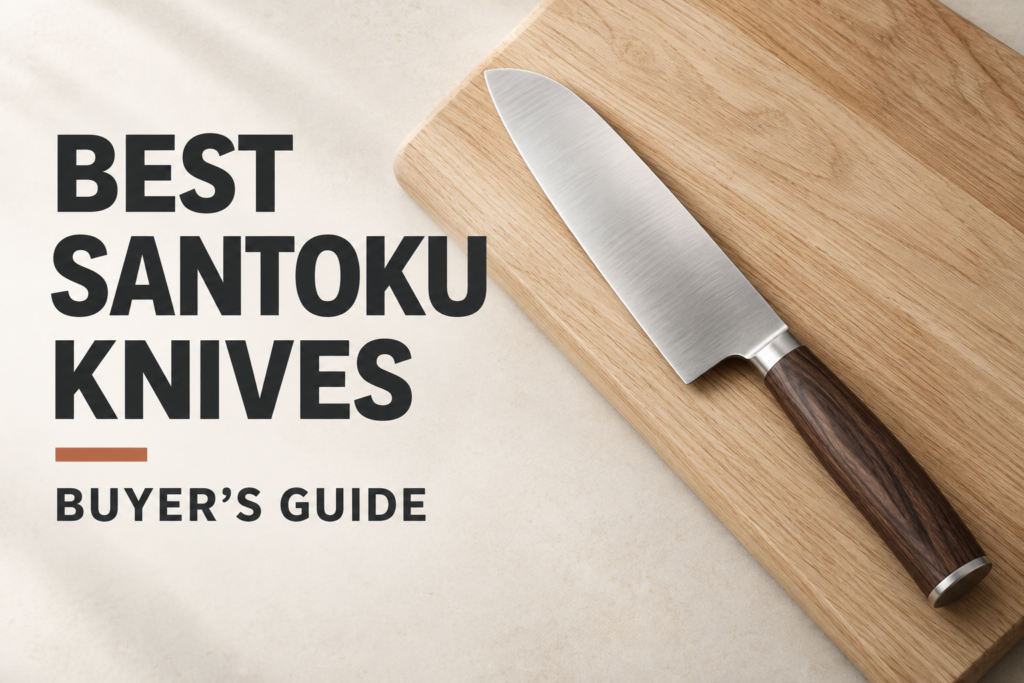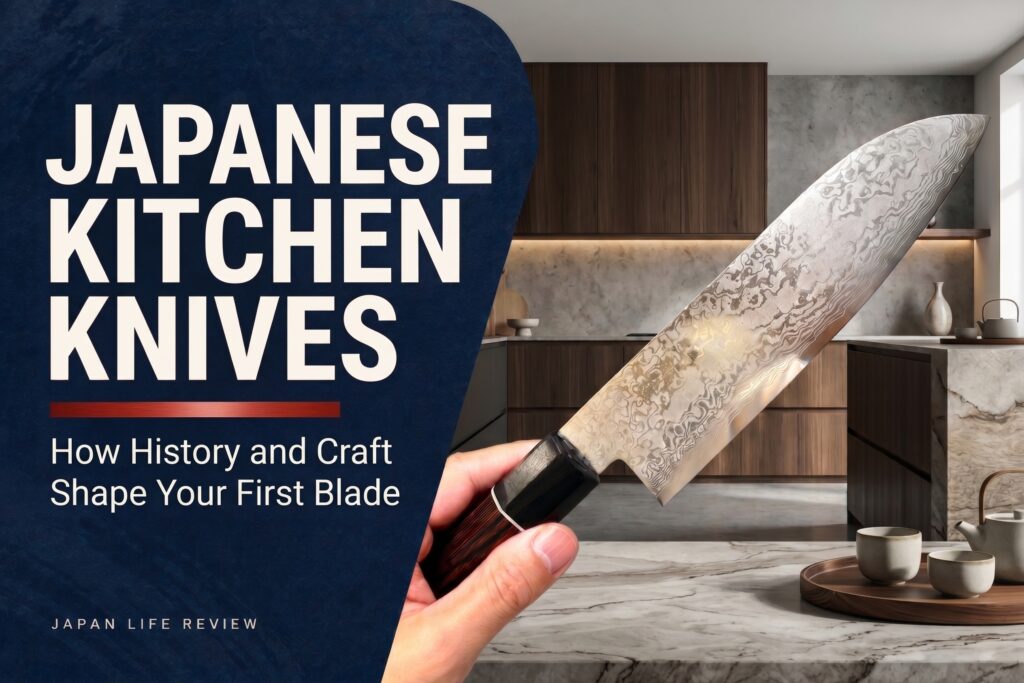
A blade with waves rippling across the steel. A handle of quiet, warm wood. If you’ve ever looked at a Japanese kitchen knife and thought I’d like one of those on my own counter, you’re not alone.
Then the questions start. There are so many types, and such a spread of prices. Which one? And is the upkeep going to be a problem?
Here’s the good news: you don’t need to learn a vocabulary of Japanese metallurgy to appreciate these knives, or to buy a good one. Three things — the history, the craftspeople, and one clever piece of construction — will tell you most of what’s worth knowing. At the end, we’ll look at where to start.
History: From Swordsmiths to the Kitchen Counter
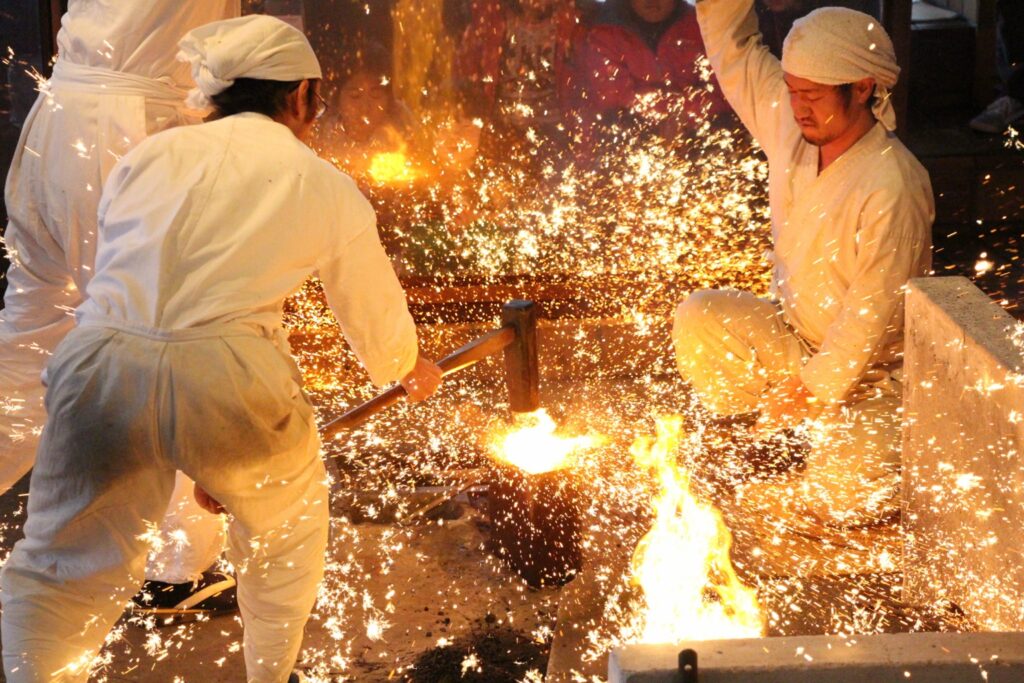
Caption: Traditional Japanese blacksmithing. Illustrative only — not the workshop behind any particular knife.
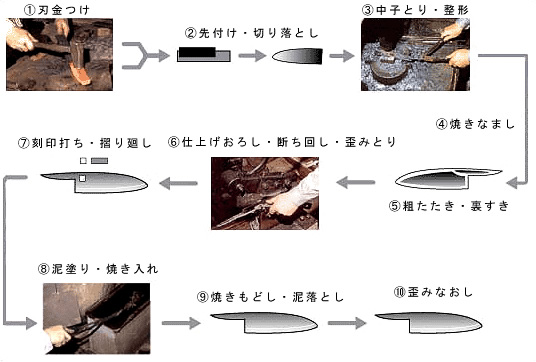
Heat the metal. Strike it into shape. Grind the edge. In Japan, this sequence has been refined over a very long time.
Seki, in Gifu Prefecture, has been forging blades for more than 800 years. The skills that once produced swords now go into kitchen knives and scissors made in the same town.
But swords are only half the story. Japanese knives also descend from farm tools and from blades built to process food and raw materials. In Sakai, Osaka, knives for shredding tobacco leaf were being made well before the Meiji era.
The knife you eventually put in your kitchen drawer sits at the end of one of these long lines. Knowing a little about the town it came from doesn’t change how it cuts. It does change how it feels to pick it up.
Craft: One Knife, Many Hands
Forging is only part of making a knife.
In Sakai, the smith who forges the blade and the sharpener who puts the edge on it are two different specialists. The work is handed from one to the next, like a relay.
Forging heats and hammers the steel into the shape of a knife. Sharpening then sets the thickness and angle of the edge and brings it to something that will actually cut food.
Which is the point worth taking away: the steel alone doesn’t decide how a knife performs. How that steel is shaped, and how the edge is ground, matter just as much.
Carbon or stainless? The honest answer
This is where most first-time buyers get stuck, and it’s worth clearing up here.
For a long time, carbon steel was the only serious choice. It takes a beautifully keen edge and is a pleasure to sharpen. It also rusts the moment you leave it wet, and it darkens with use into a patina — a mottled grey-blue surface that owners come to treat as a record of everything they’ve cooked.
Modern stainless steels have closed most of that gap. Grades developed over the past few decades come genuinely close to carbon steel on sharpness and can hold an edge longer, while asking almost nothing of you in return. Carbon steel still sharpens a little more easily and can be taken a fraction finer — but for most cooks, on most days, the difference is smaller than the inconvenience.
So the choice is less about performance than about temperament:
- Carbon steel suits someone who enjoys the upkeep, and likes the idea of a blade that changes and deepens with age. It rewards attention.
- Stainless steel suits nearly everyone else. It’s the practical answer, and no longer the compromise it once was.
Methods vary by region and by maker. But when you can see who made a knife and where, you start looking at it differently — not only at whether it’s beautiful, but at the work that went into it.
Construction: A Hard Core, Supported
Caption: Examples of laminated blade construction. The layering varies from maker to maker.
Many Japanese knives combine two or more metals with different properties.
The easiest version to picture is a sandwich: a hard core layered between softer metal on both sides.
- The core does the cutting. It’s the hard steel that becomes the edge.
- The outer layers support it. Often stainless, which makes the flat of the blade less prone to rust.
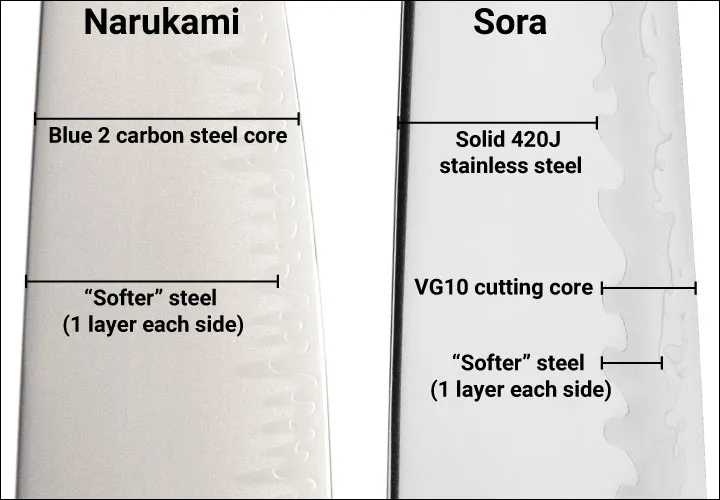
The idea is to use the hard steel where hardness matters and let a more forgiving metal handle everything else. Each material does the job it’s suited to.
Construction isn’t the whole answer, though. The thickness of the blade and the way it’s sharpened both shape how it feels in use. And a hard edge is still a hard edge: cut through bone, or twist the blade sideways, and it can chip.
For a First Knife at Home: the Santoku
Japanese knives include the deba for breaking down fish, the yanagiba for slicing sashimi, the nakiri for vegetables — each built for one job.
For a first knife in a home kitchen, though, the one I’d point you toward is the santoku.
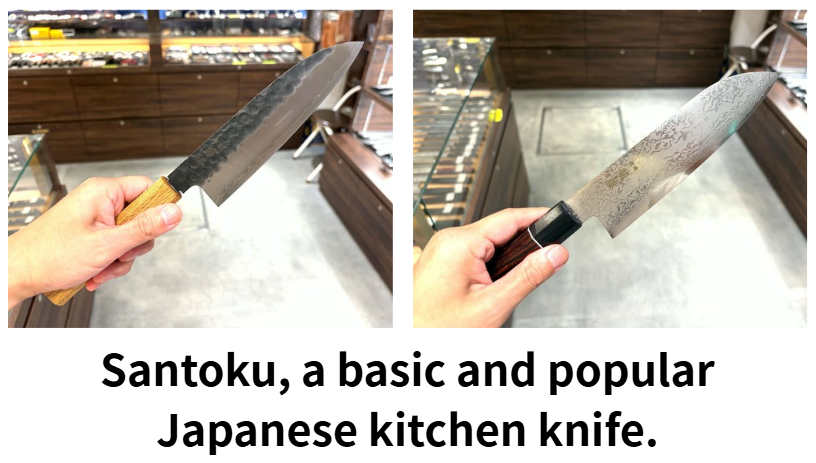
The santoku is the generalist: meat, fish and vegetables, all handled well enough that you rarely need to reach for anything else. Chopping vegetables for dinner, portioning boneless meat, working with a fish fillet — everyday prep. Blades typically run 165–180mm.
When I visited a knife shop in Ginza and asked what people actually buy, the answer was the santoku. It’s balanced, the staff told me, which makes it easy to recommend.
Don’t start with a set. Start with one knife you’ll use in the cooking you already do.
Keeping it simple
Whichever steel you choose, the routine is short: wash it by hand after use, dry it, put it away. Don’t cut bones or frozen food with a thin blade, and don’t twist the edge sideways. Beyond that, follow whatever instructions come with your knife.
If you’d rather not think about any of this, that’s your answer for the steel question too — go stainless.
Buy something you like looking at
Warm wood handles. Deep black forged finishes. The wave-like ripple of a Damascus pattern. Which of these appeals to you is part of the decision, and there’s nothing frivolous about that.
At the shop I visited, I was told the knives that sell are the ones that look distinctly Japanese, rather than the sleeker modern designs.
A pattern tells you nothing about performance. But this is a tool you’ll handle almost every day for years, and wanting to pick it up has real value.
Where to Find One
Santoku knives are made across Japan, in a wide range of steels, finishes and prices. Rather than pointing you at a single blade, it’s more useful to point you at a shop that tells you what you’re actually buying.
Why BECOS
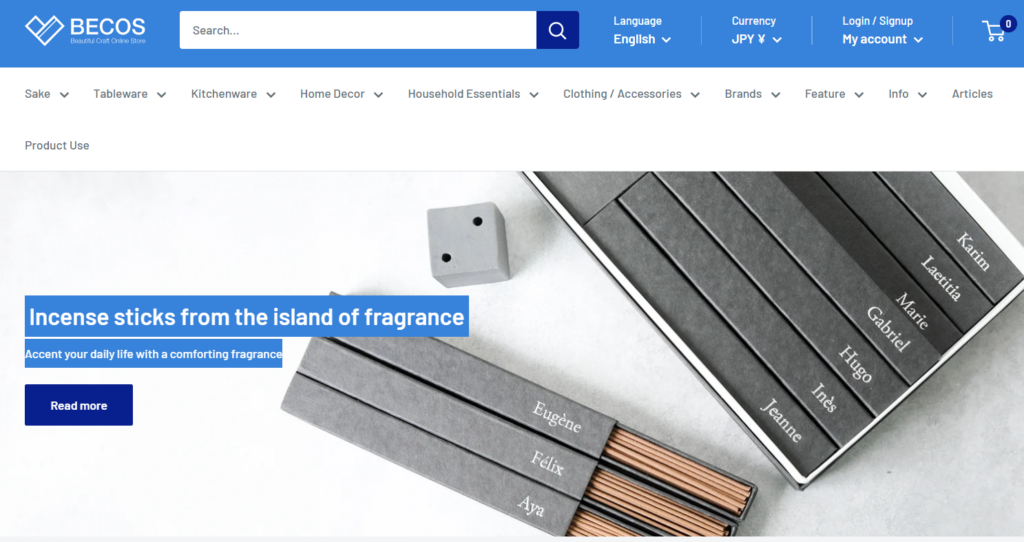
BECOS is a Tokyo-based online store specialising in authentic Japanese crafts, shipping worldwide. Unlike an open marketplace, every item is chosen by buyers who visit the workshops in person — so you always know who made it, where, and from what. For knives, that means every listing names the workshop, the region and the steel it’s made from.
That single detail is the best filter you have. A listing that names its maker, its town and its steel is making a claim it can be held to. A listing that says only “Japanese steel” is telling you nothing at all.
How ordering works
| Where | en.thebecos.com, shipped from Tokyo |
| Account | Not required — guest checkout is available |
| Payment | Visa, Mastercard, Amex, JCB, PayPal, Apple Pay, Google Pay, Shop Pay |
| Currency | Shown in your own — over 100 supported |
| Shipping | $25 to North America, Europe, Oceania and Africa; $15 to Asia. Free over $250 |
| Delivery | 6–12 business days standard; 2–5 business days with Premium Express |
| Duties | Often calculated and prepaid at checkout, including the carrier’s handling fee — so there’s nothing to pay at the door |
One thing worth knowing before you browse: knives marked “Backorder OK” are not sold out. They can still be ordered; they simply take longer to ship, because many are made in small batches by hand.
Stock on any single knife can be limited, so it’s worth looking across the full range rather than fixing on one listing. Prices, availability and shipping terms are all shown on the product pages.
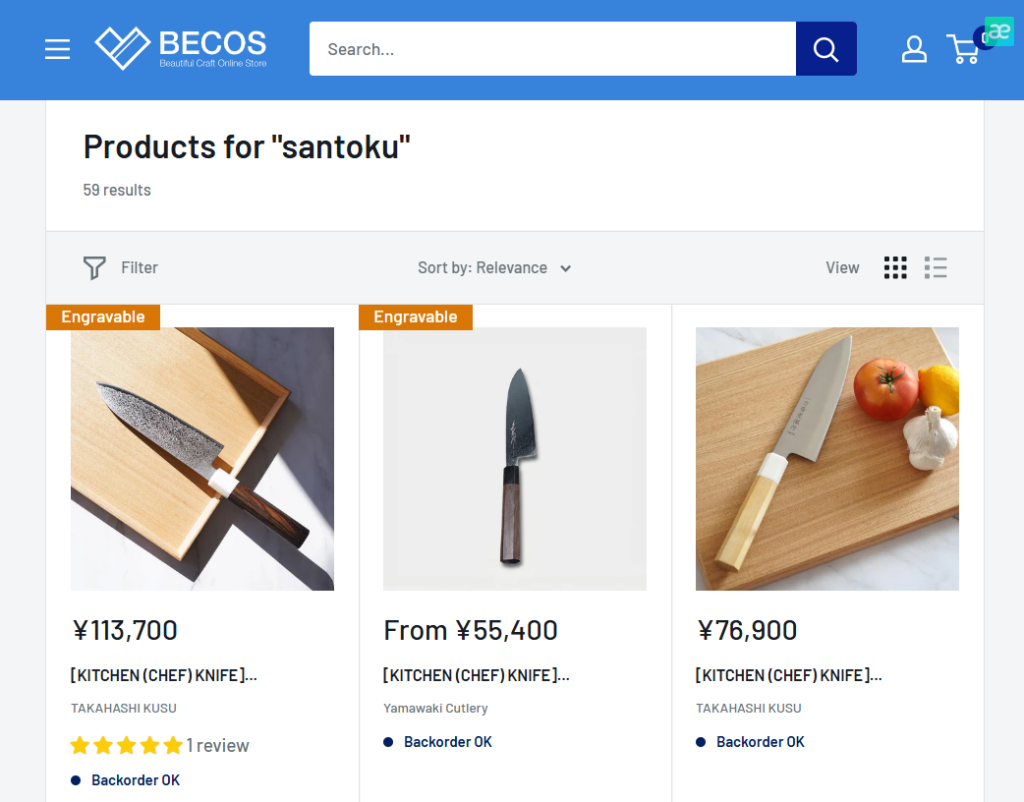
→ Shop santoku knives at BECOS
If you want to bring a Japanese knife into your kitchen, start with the one you’ll use most. Learn a little about where it came from. Keep it clean and sharp. That turns out to be part of the pleasure of cooking, too.