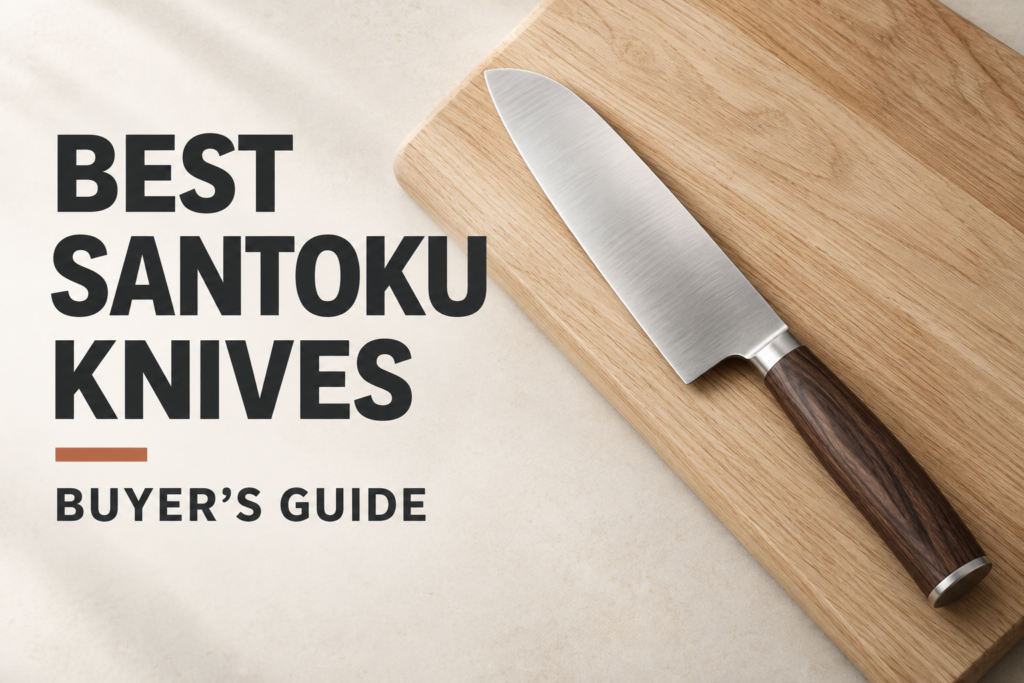
You’ve decided you want a Japanese knife, and the word that keeps coming up is santoku. Good instinct — it’s the knife most Japanese households actually reach for every day.
The problem is what comes next. Search for one and you’ll find knives at $40 and knives at $700, both called a santoku, both photographed against the same grey background. Nothing on the page tells you what the difference is.
This guide is about that difference — what actually changes the price, what’s worth paying for, and three knives we’d recommend without hesitation.
What a Santoku Is — and Why It’s Not Just a Small Chef’s Knife
Santoku means “three virtues”: meat, fish and vegetables. It appeared in Japan in the 1940s, when home cooking was shifting and households wanted one knife instead of the three specialists they’d used before.
Sitting next to a Western chef’s knife, three things stand out.
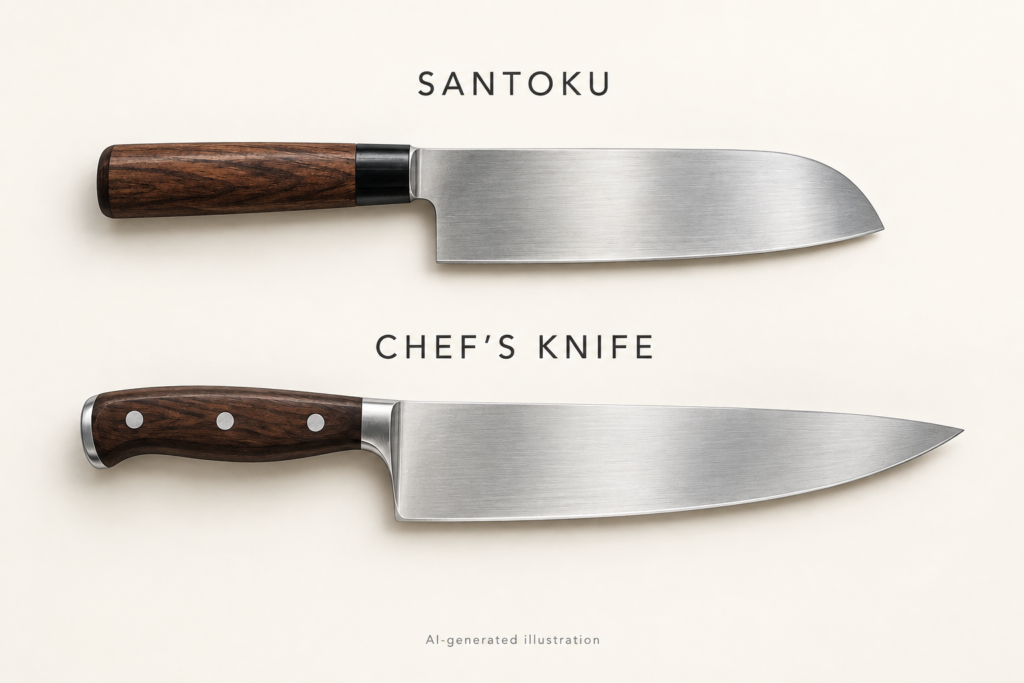
It’s shorter. A Western chef’s knife runs 200–250mm; a santoku is 165–180mm. That makes it easier to control and easier to store. You will struggle with a large roast, so don’t throw out the big knife you already own. But for everything else it’s a different experience — tomatoes, onions, cucumbers, apples all come away in clean slices instead of being crushed on the way through.
The edge is flatter. A chef’s knife has a pronounced curve so you can rock it through herbs. A santoku’s edge is closer to straight, so more of the blade meets the board on every stroke. That suits a straight downward chop or a forward push cut — lift, come down, move along. If you’ve spent years rocking a chef’s knife, this will feel unfamiliar at first.
It’s thinner. This is the one people underestimate. Measure the spine — the blunt top edge — and a Western chef’s knife usually runs 3.0–4.0mm. A Japanese santoku is typically 1.8–2.5mm. Roughly half the metal pushing through the food, which is exactly why the cut is cleaner. Japanese knives can be built this thin because they use harder steel; a softer blade ground this fine would simply fold over in use.
The trade-off is honest and worth knowing up front: a harder blade is sharper for longer, and it chips more easily if you abuse it. More on that in the FAQ.
How to Choose a Santoku: Four Quick Decisions
Four choices, and none of them takes long.
1. Stainless or carbon steel?
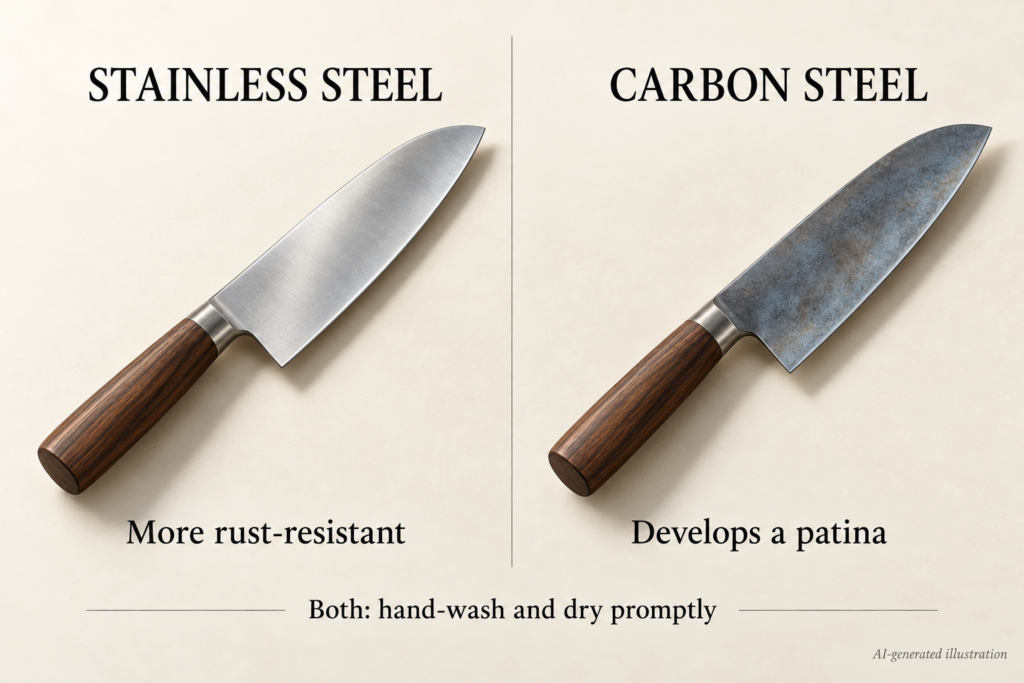
This is the one that matters. Stainless won’t rust and asks nothing of you — look for SG2, Ginsan or VG10 on the listing. Carbon steel gets sharper still and is a pleasure to sharpen, but you have to dry it the moment you wash it, and it darkens with age. Look for Aogami Super or Shirogami.
If this is your first Japanese knife, buy stainless.
2. What size?
165mm for smaller hands or a tight kitchen. 170mm if you’re unsure. 180mm if you cook a lot and have room to work.
3. How should it look?
Blades come black and rough straight from the forge (kurouchi), patterned like wood grain (Damascus), dimpled by a hammer, or simply polished. They all cut the same, so choose the one you’d enjoy looking at every day. Just know that Damascus is a pattern, not a mark of quality — what counts is the steel underneath it.
Most Japanese knives come with a light wooden handle, usually octagonal rather than riveted like a Western one. That’s the standard in Japan for good reason: it suits either hand and doesn’t slip when wet.
4. Who made it?
Sakai, Echizen and Seki are Japan’s three knife towns. Each has its own style, and any of them is a good answer.
What actually matters is simpler: does the listing name the workshop, the town and the steel? If it only says “Japanese steel,” move on. That single check removes most of the risk of buying a knife online.
Where to Buy — and What to Check First
Three routes exist, and they’re genuinely different.
Buying in Japan is wonderful if you’re going anyway. It’s not a plan if you’re not.
General marketplaces carry an enormous range at every price, listed by many independent sellers. The catch isn’t price — it’s information. When a listing says “Damascus VG10 Japanese steel” and names no workshop, no region and no maker, there’s no way to verify what you’re getting, and no one to ask. As covered above, Damascus is a pattern, not a grade.
Specialist retailers are the middle path. There are a number of good ones shipping from Japan in English, and among them the one we’d point you to is BECOS.
Why BECOS
BECOS is a Tokyo-based store selling crafts by artisans across Japan, founded in 2017 by Kentaro Kashimura. Its buyers visit the workshops, talk to the makers, and handle the products before anything is listed — an approach the company openly calls inefficient and has no intention of changing. The stated principle is quality over quantity, longevity over trendiness. For an object you intend to sharpen and keep for thirty years, that’s the right bias.
For knives, two things matter most. Every listing names the workshop, the region and the steel — not “a Japanese knife,” but an Aogami Super blade forged by Iwai Cutlery in Echizen, or a Ginsan Damascus from Yamawaki Cutlery in Sakai. That’s the test described above, and BECOS passes it on every product. And it curates across regions: most Japanese specialists represent one town or one brand, while BECOS carries Sakai, Echizen and Seki side by side, so you can actually compare traditions before you choose.
Ordering, Shipping and Duties
| Item | Details |
|---|---|
| Account needed? | No. You can check out as a guest, though registering lets you track orders on My Page. |
| Payment | Credit cards (Visa, Mastercard, Amex, JCB), PayPal, Apple Pay, Google Pay, Shop Pay. |
| Currency | Displayed in your own — over 100 supported. |
| Shipping cost | Standard: $25 to North America, Europe, Oceania and Africa; $15 to Asia. Free on orders of $250 and over. |
| Delivery time | Standard: 6–12 business days. Premium Express (2–5 business days) available at checkout. Backordered items take longer. |
| Ships from | Tokyo, anywhere Japan Post, FedEx or DHL delivers. |
| Engraving | Available on many knives — worth checking if it’s a gift. |
A word on customs duties, since this is where international orders usually go wrong. At BECOS, duties may be calculated at checkout and shown as a separate line. When they are, they’re prepaid — BECOS pays customs on your behalf and also covers the carrier’s duty-advancement fee of around $15, so nothing further is owed on delivery. When they aren’t collected at checkout, duties are payable to the carrier on arrival as normal.
That single detail is worth more than it sounds. The classic bad experience with an imported knife isn’t the knife — it’s a courier at the door asking for an unexpected $60 before they’ll hand over the box.
Two of our three picks below sit above the $250 free-shipping threshold, which is worth keeping in mind as you choose.
Our Top 3 Santoku Knives
Three knives, deliberately different from each other, so one of them is yours.
1. SG2 Santoku 180mm, Oak Octagonal Handle — Seki
$460.80
If you want the best-performing santoku that still lets you live a normal life, this is it. SG2 is a powder-metallurgy stainless running HRC 62–64 — it holds a working edge dramatically longer than ordinary stainless, yet sharpens more easily than most steels of comparable hardness. Being stainless, it doesn’t punish you for leaving it on the rack for an hour. The 180mm length and octagonal oak handle make it a serious everyday tool rather than a display piece, and it can be engraved. If you only read one recommendation on this page, read this one.
Best for: everyday cooks who want maximum performance and minimum anxiety.
2. Kurouchi Santoku 170mm, Aogami Super — Echizen, Iwai Cutlery
$264.00
This is the one that looks like it came out of a forge, because it did. The black oxide skin is left exactly as the fire produced it, so no two are identical. Inside is Aogami Super, the top of Japan’s carbon steel family at roughly HRC 62–65 — extraordinary sharpness and long edge life, in exchange for a rule you must follow: dry it immediately after washing. Over the years it will darken into a patina that is entirely your own. Forged in Echizen, where they’ve been doing this for seven centuries.
Best for: people who want the real thing, and don’t mind a towel.
3. Gin3 Damascus Santoku 180mm — Sakai, Yamawaki Cutlery
From $325.20
The knife people pick up and don’t put down. The Damascus pattern is genuine layered construction, and the core is Ginsan — a stainless steel with a sharpening feel unusually close to white carbon steel, which is why experienced buyers seek it out. Made in Sakai, where forging, sharpening and handle-fitting are each done by a different specialist. Engraving available, which makes it a strong gift.
Best for: buyers who want beauty and substance in the same object.
On a tighter budget? The Forged Black Santoku 170mm from Iwai Cutlery is $180.00 and still a genuine hand-forged Echizen blade — a real knife, not a compromise.
Prices as listed at the time of writing; check the current price and stock before ordering.
Will a Japanese knife rust?
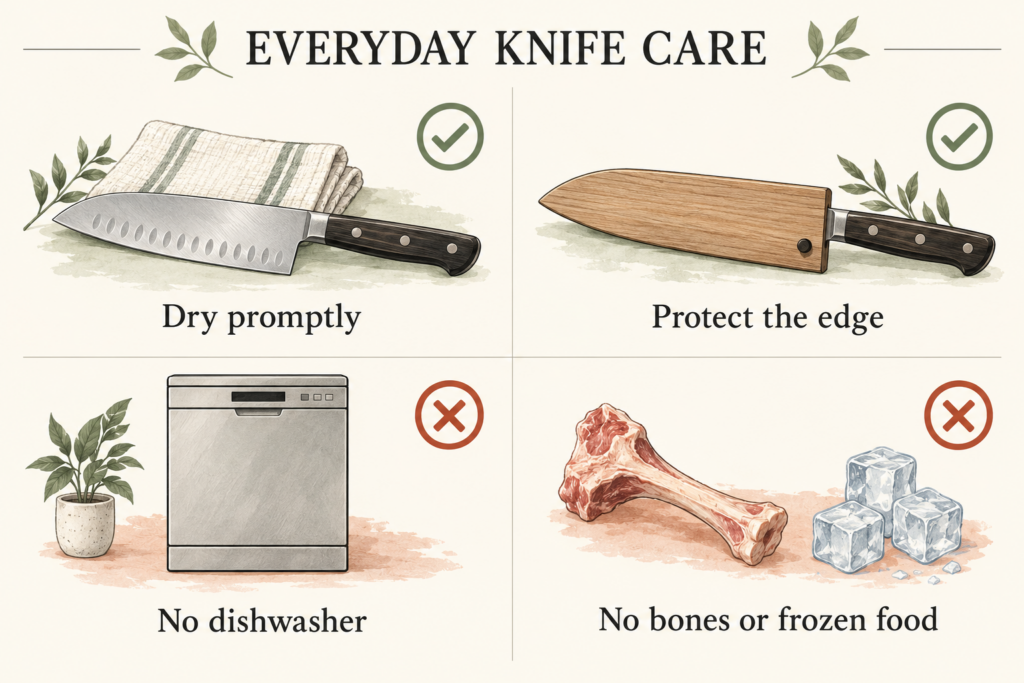
Carbon steel will, if you leave it wet. Stainless won’t, in normal use. Either way: wash by hand, dry immediately, don’t leave it in the sink. That’s the whole routine.
Can I put it in the dishwasher?
No. Heat, detergent and knocking against other items will damage both the edge and a wooden handle. This applies to every knife at this level, Japanese or not.
Will it chip?
It can. Hard steel is sharper for longer and less tolerant of abuse. Three rules cover almost every case: don’t cut bones, frozen food or anything harder than a raw potato; don’t twist the blade sideways; and use a wood or soft-rubber cutting board rather than glass, stone or bamboo. Follow those and chipping is rare.
How do I sharpen it?
A whetstone, ideally a #1000 for sharpening and a #3000–6000 for finishing. Japanese steel sharpens beautifully and quickly. Avoid pull-through sharpeners — they’re ground for softer Western edges and will take far more metal than you want.
How long will delivery take?
From BECOS, standard shipping runs 6–12 business days from Tokyo, with a 2–5 business day express option at checkout. Items on backorder take longer, so check the stock status on the product page.
Santoku or gyuto?
If you rock your chef’s knife through herbs and want to keep that motion, look at a gyuto instead — it’s the Japanese take on the Western chef’s knife shape. If you chop straight down, the santoku is the better fit.